


Super User
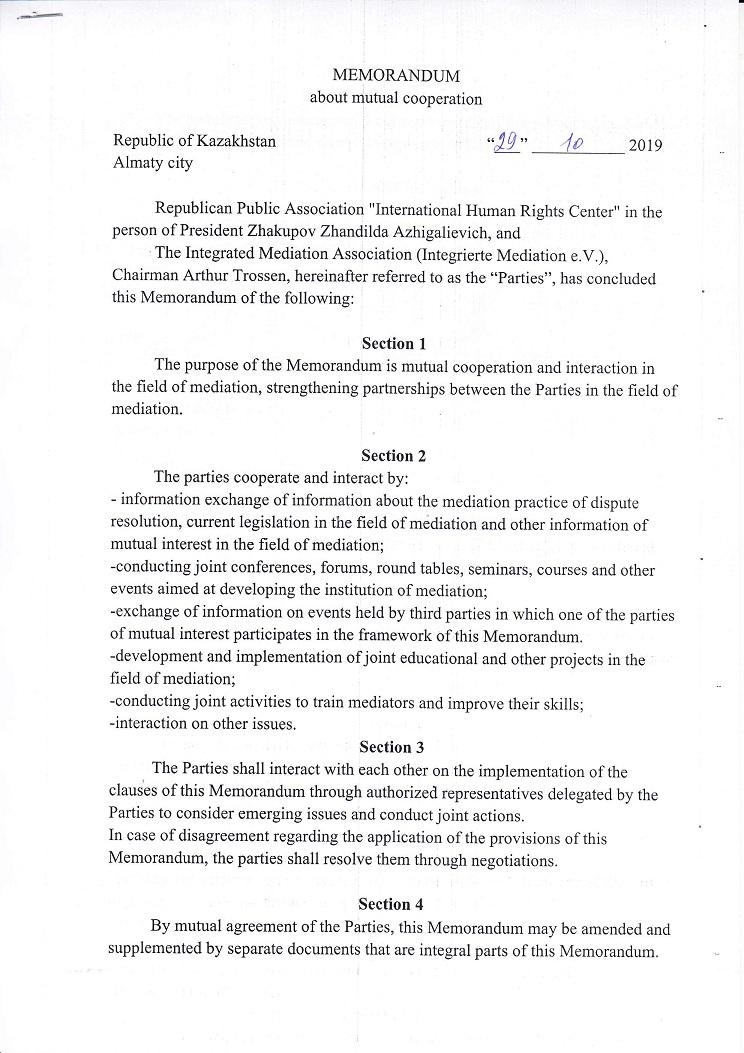
Меморандум о сотрудничестве с Центром социального взаимодействий и коммуникаций АО "Самрук-Казына"


Семейная медиация
Уголовная медиация
Курс подготовки тренеров-медиаторов
ПРОГРАММА
«Курса подготовки тренеров-медиаторов»
(в объеме 32 часа)
Курс предназначен для профессиональных медиаторов, прошедших обучающие программы «Общий курс медиации» и «Специализированный курс медиации». Цели курса - освоения теории и практики преподавания профессиональной медиации и обучения профессиональных медиаторов. Курс направлен на получение слушателями знаний, умений и навыков тренера медиаторов.
Данный курс разработан в соответствии с Законом РК «О медиации» и Правилами прохождения обучения по программе подготовки медиаторов, утвержденными Постановлением Правительства от 3 июля 2011 года № 770.
Продолжительность курса - 32 академических часа или 3 дня.
Занятия проводятся ежедневно с 09:00 до 18:00 с перерывами на кофе-паузы (в 11:15 и 16:15) и обед с 13:00 до 14:00.
Формат семинара:
- подача теоретического материала – 30 % времени обучения;
- практическая работа индивидуально и в группах с использованием brain-storming, case-study, деловых и ролевых игр и прочее — 60% времени обучения;
- демонстрация видео и аудио материалов для выработки и закрепления отдельных навыков, показа отдельных практических кейсов — 10% времени обучения.
4) оценка приобретенных слушателями навыков переговорного процесса и сдача итогового экзамена путем письменного и устного тестирования и проведения обучения медиации.
По окончании курса в случае положительной сдачи экзамена слушатели получают квалификацию и сертификат тренера-медиатора, методическое пособие с кратким изложением курса, посттренинговое консультирование. Кроме того, предлагается постановка в реестр тренеров-медиаторов Центра медиации РОО «Международный правозащитный центр».
Записаться на курс и получить подробную программу курса можно будет у менеджера Жекебаева Турсына по тел.87473202313, 87782006217, 87773988627, электр.почта: This email address is being protected from spambots. You need JavaScript enabled to view it..
Курс подготовки тренеров-медиаторов
ПРОГРАММА
«Курса подготовки тренеров-медиаторов»
(в объеме 32 часа)
Курс предназначен для профессиональных медиаторов, прошедших обучающие программы «Общий курс медиации» и «Специализированный курс медиации». Цели курса - освоения теории и практики преподавания профессиональной медиации и обучения профессиональных медиаторов. Курс направлен на получение слушателями знаний, умений и навыков тренера медиаторов.
Данный курс разработан в соответствии с Законом РК «О медиации» и Правилами прохождения обучения по программе подготовки медиаторов, утвержденными Постановлением Правительства от 3 июля 2011 года № 770.
Продолжительность курса - 32 академических часа или 3 дня.
Занятия проводятся ежедневно с 09:00 до 18:00 с перерывами на кофе-паузы (в 11:15 и 16:15) и обед с 13:00 до 14:00.
Формат семинара:
- подача теоретического материала – 30 % времени обучения;
- практическая работа индивидуально и в группах с использованием brain-storming, case-study, деловых и ролевых игр и прочее — 60% времени обучения;
- демонстрация видео и аудио материалов для выработки и закрепления отдельных навыков, показа отдельных практических кейсов — 10% времени обучения.
4) оценка приобретенных слушателями навыков переговорного процесса и сдача итогового экзамена путем письменного и устного тестирования и проведения обучения медиации.
По окончании курса в случае положительной сдачи экзамена слушатели получают квалификацию и сертификат тренера-медиатора, методическое пособие с кратким изложением курса, посттренинговое консультирование. Кроме того, предлагается постановка в реестр тренеров-медиаторов Центра медиации РОО «Международный правозащитный центр».
Записаться на курс и получить подробную программу курса можно будет у менеджера Жекебаева Турсына по тел.87473202313, 87782006217, 87773988627, электр.почта: This email address is being protected from spambots. You need JavaScript enabled to view it..
Специализированный курс медиации
ПРОГРАММА
«Специализированный курс медиации»
(в объеме 50 часов)
Курс предназначен для профессиональных медиаторов, прошедших обучающую программу «Общий курс медиации». Цель курса – повышение квалификации профессиональных медиаторов, углубленное изучение направлений медиации, особенностей ее проведения. Участники курса изучают модели и технологии медиации, особенности проведения уголовной, семейной, трудовой, гражданско-правовой, коммерческой, социальной, экологической медиации.
Данный курс разработан в соответствии с Законом РК «О медиации» и Правилами прохождения обучения по программе подготовки медиаторов, утвержденными Постановлением Правительства от 3 июля 2011 года № 770.
Продолжительность курса - 50 академических часов или 5 дней.
Занятия проводятся ежедневно с 09:00 до 18:00 с перерывами на кофе-паузы (в 11:15 и 16:15) и обед с 13:00 до 14:00.
Формат семинара:
- подача теоретического материала – 30 % времени обучения;
- практическая работа индивидуально и в группах с использованием brain-storming, case-study, деловых и ролевых игр и прочее — 60% времени обучения;
- демонстрация видео и аудио материалов для выработки и закрепления отдельных навыков, показа отдельных практических кейсов — 10% времени обучения.
4) оценка приобретенных слушателями навыков переговорного процесса и сдача итогового экзамена путем письменного и устного тестирования и проведения обучения медиации.
По окончании курса в случае положительной сдачи экзамена слушатели повышают квалификацию и получают сертификат о прохождении обучения по программе «Специализированный курс медиации», методическое пособие с кратким изложением курса, посттренинговое консультирование.
Записаться на курс и получить подробную программу курса можно будет у менеджера Жекебаева Турсына по тел.87473202313, 87782006217, 87773988627, электр.почта: This email address is being protected from spambots. You need JavaScript enabled to view it.
United Nations Convention on International Settlement Agreements Resulting from Mediation
Preamble
The Parties to this Convention,
Recognizing the value for international trade of mediation as a method for
settling commercial disputes in which the parties in dispute request a third person or
persons to assist them in their attempt to settle the dispute amicably,
Noting that mediation is increasingly used in international and domestic
commercial practice as an alternative to litigation,
Considering that the use of mediation results in significant benefits, such as
reducing the instances where a dispute leads to the termination of a commercial
relationship, facilitating the administration of international transactions by
commercial parties and producing savings in the administration of justice by States,
Convinced that the establishment of a framework for international settlement
agreements resulting from mediation that is acceptable to States with different legal,
social and economic systems would contribute to the development of harmonious
international economic relations,
Have agreed as follows:
Article 1. Scope of application
- This Convention applies to an agreement resulting from mediation and
concluded in writing by parties to resolve a commercial dispute (“settlement
agreement”) which, at the time of its conclusion, is international in that:
(a) At least two parties to the settlement agreement have their places of
business in different States; or
(b) The State in which the parties to the settlement agreement have their places
of business is different from either:
(i) The State in which a substantial part of the obligations under the settlement
agreement is performed; or
(ii) The State with which the subject matter of the settlement agreement is
most closely connected.
- This Convention does not apply to settlement agreements:
(a) Concluded to resolve a dispute arising from transactions engaged in by
one of the parties (a consumer) for personal, family or household purposes;
(b) Relating to family, inheritance or employment law.
- This Convention does not apply to:
(a) Settlement agreements:
(i) That have been approved by a court or concluded in the course of
proceedings before a court; and
(ii) That are enforceable as a judgment in the State of that court;
(b) Settlement agreements that have been recorded and are enforceable as an
arbitral award.
V.18-05221 51
A/73/17
Article 2. Definitions
- For the purposes of article 1, paragraph 1:
(a) If a party has more than one place of business, the relevant place of
business is that which has the closest relationship to the dispute resolved by the
settlement agreement, having regard to the circumstances known to, or contemplated
by, the parties at the time of the conclusion of the settlement agreement;
(b) If a party does not have a place of business, reference is to be made to the
party’s habitual residence.
- A settlement agreement is “in writing” if its content is recorded in any form.
The requirement that a settlement agreement be in writing is met by an electronic
communication if the information contained therein is accessible so as to be useable
for subsequent reference.
- “Mediation” means a process, irrespective of the expression used or the basis
upon which the process is carried out, whereby parties attempt to reach an amicable
settlement of their dispute with the assistance of a third person or persons (“the
mediator”) lacking the authority to impose a solution upon the parties to the dispute.
Article 3. General principles
- Each Party to the Convention shall enforce a settlement agreement in
accordance with its rules of procedure and under the conditions laid down in this
Convention.
- If a dispute arises concerning a matter that a party claims was already resolved
by a settlement agreement, a Party to the Convention shall allow the party to invoke
the settlement agreement in accordance with its rules of procedure and under the
conditions laid down in this Convention, in order to prove that the matter has already
been resolved.
Article 4. Requirements for reliance on settlement agreements
- A party relying on a settlement agreement under this Convention shall supply to
the competent authority of the Party to the Convention where relief is sought:
(a) The settlement agreement signed by the parties;
(b) Evidence that the settlement agreement resulted from mediation, such as:
(i) The mediator’s signature on the settlement agreement;
(ii) A document signed by the mediator indicating that the mediation was
carried out;
(iii) An attestation by the institution that administered the mediation; or
(iv) In the absence of (i), (ii) or (iii), any other evidence acceptable to the
competent authority.
- The requirement that a settlement agreement shall be signed by the parties or,
where applicable, the mediator is met in relation to an electronic communication if:
(a) A method is used to identify the parties or the mediator and to indicate the
parties’ or mediator’s intention in respect of the information contained in the
electronic communication; and
(b) The method used is either:
(i) As reliable as appropriate for the purpose for which the electronic
communication was generated or communicated, in the light of all the
circumstances, including any relevant agreement; or
(ii) Proven in fact to have fulfilled the functions described in subparagraph (a)
above, by itself or together with further evidence.
52 V.18-05221
A/73/17
- If the settlement agreement is not in an official language of the Party to the
Convention where relief is sought, the competent authority may request a translation
thereof into such language.
- The competent authority may require any necessary document in order to verify
that the requirements of the Convention have been complied with.
- When considering the request for relief, the competent authority shall act
expeditiously.
Article 5. Grounds for refusing to grant relief
- The competent authority of the Party to the Convention where relief is sought
under article 4 may refuse to grant relief at the request of the party against whom the
relief is sought only if that party furnishes to the competent authority proof that:
(a) A party to the settlement agreement was under some incapacity;
(b) The settlement agreement sought to be relied upon:
(i) Is null and void, inoperative or incapable of being performed under the
law to which the parties have validly subjected it or, failing any indication
thereon, under the law deemed applicable by the competent authority of the
Party to the Convention where relief is sought under article 4;
(ii) Is not binding, or is not final, according to its terms; or
(iii) Has been subsequently modified;
(c) The obligations in the settlement agreement:
(i) Have been performed; or
(ii) Are not clear or comprehensible;
(d) Granting relief would be contrary to the terms of the settlement agreement;
(e) There was a serious breach by the mediator of standards applicable to the
mediator or the mediation without which breach that party would not have entered
into the settlement agreement; or
(f) There was a failure by the mediator to disclose to the parties circumstances
that raise justifiable doubts as to the mediator’s impartiality or independence and such
failure to disclose had a material impact or undue influence on a party without which
failure that party would not have entered into the settlement agreement.
- The competent authority of the Party to the Convention where relief is sought
under article 4 may also refuse to grant relief if it finds that:
(a) Granting relief would be contrary to the public policy of that Party; or
(b) The subject matter of the dispute is not capable of settlement by mediation
under the law of that Party.
Article 6. Parallel applications or claims
If an application or a claim relating to a settlement agreement has been made to
a court, an arbitral tribunal or any other competent authority which may affect the
relief being sought under article 4, the competent authority of the Party to the
Convention where such relief is sought may, if it considers it proper, adjourn the
decision and may also, on the request of a party, order the other party to give suitable
security.
Article 7. Other laws or treaties
This Convention shall not deprive any interested party of any right it may have
to avail itself of a settlement agreement in the manner and to the extent allowed by
V.18-05221 53
A/73/17
the law or the treaties of the Party to the Convention where such settlement agreement
is sought to be relied upon.
Article 8. Reservations
- A Party to the Convention may declare that:
(a) It shall not apply this Convention to settlement agreements to which it is
a party, or to which any governmental agencies or any person acting on behalf of a
governmental agency is a party, to the extent specified in the declaration;
(b) It shall apply this Convention only to the extent that the parties to the
settlement agreement have agreed to the application of the Convention.
- No reservations are permitted except those expressly authorized in this article.
- Reservations may be made by a Party to the Convention at any time.
Reservations made at the time of signature shall be subject to confirmation upon
ratification, acceptance or approval. Such reservations shall take effect
simultaneously with the entry into force of this Convention in respect of the Party to
the Convention concerned. Reservations made at the time of ratification, acceptance
or approval of this Convention or accession thereto, or at the time of making a
declaration under article 13 shall take effect simultaneously with the entry into force
of this Convention in respect of the Party to the Convention concerned. Reservations
deposited after the entry into force of the Convention for that Party to the Convention
shall take effect six months after the date of the deposit.
- Reservations and their confirmations shall be deposited with the depositary.
- Any Party to the Convention that makes a reservation under this Convention
may withdraw it at any time. Such withdrawals are to be deposited with the depositary,
and shall take effect six months after deposit.
Article 9. Effect on settlement agreements
The Convention and any reservation or withdrawal thereof shall apply only to
settlement agreements concluded after the date when the Convention, reservation or
withdrawal thereof enters into force for the Party to the Convention concerned.
Article 10. Depositary
The Secretary-General of the United Nations is hereby designated as the
depositary of this Convention.
Article 11. Signature, ratification, acceptance, approval, accession
- This Convention is open for signature by all States in Singapore, on 1 August
2019, and thereafter at United Nations Headquarters in New York.
- This Convention is subject to ratification, acceptance or approval by the
signatories.
- This Convention is open for accession by all States that are not signatories as
from the date it is open for signature.
- Instruments of ratification, acceptance, approval or accession are to be deposited
with the depositary.
Article 12. Participation by regional economic
integration organizations
- A regional economic integration organization that is constituted by sovereign
States and has competence over certain matters governed by this Convention may
similarly sign, ratify, accept, approve or accede to this Convention. The regional
economic integration organization shall in that case have the rights and obligations of
a Party to the Convention, to the extent that that organization has competence over
54 V.18-05221
A/73/17
matters governed by this Convention. Where the number of Parties to the Convention
is relevant in this Convention, the regional economic integration organization shall
not count as a Party to the Convention in addition to its member States that are Parties
to the Convention.
- The regional economic integration organization shall, at the time of signature,
ratification, acceptance, approval or accession, make a declaration to the depositary
specifying the matters governed by this Convention in respect of which competence
has been transferred to that organization by its member States. The regional economic
integration organization shall promptly notify the depositary of any changes to the
distribution of competence, including new transfers of competence, specified in the
declaration under this paragraph.
- Any reference to a “Party to the Convention”, “Parties to the Convention”, a
“State” or “States” in this Convention applies equally to a regional economic
integration organization where the context so requires.
- This Convention shall not prevail over conflicting rules of a regional economic
integration organization, whether such rules were adopted or entered into force before
or after this Convention: (a) if, under article 4, relief is sought in a State that is
member of such an organization and all the States relevant under article 1,
paragraph 1, are members of such an organization; or (b) as concerns the recognition
or enforcement of judgments between member States of such an organization.
Article 13. Non-unified legal systems
- If a Party to the Convention has two or more territorial units in which different
systems of law are applicable in relation to the matters dealt with in this Convention,
it may, at the time of signature, ratification, acceptance, approval or accession, declare
that this Convention is to extend to all its territorial units or only to one or more of
them, and may amend its declaration by submitting another declaration at any time.
- These declarations are to be notified to the depositary and are to state expressly
the territorial units to which the Convention extends.
- If a Party to the Convention has two or more territorial units in which different
systems of law are applicable in relation to the matters dealt with in this Convention:
(a) Any reference to the law or rule of procedure of a State shall be construed
as referring, where appropriate, to the law or rule of procedure in force in the relevant
territorial unit;
(b) Any reference to the place of business in a State shall be construed as
referring, where appropriate, to the place of business in the relevant territorial unit;
(c) Any reference to the competent authority of the State shall be construed as
referring, where appropriate, to the competent authority in the relevant territorial unit.
- If a Party to the Convention makes no declaration under paragraph 1 of this
article, the Convention is to extend to all territorial units of that State.
Article 14. Entry into force
- This Convention shall enter into force six months after deposit of the third
instrument of ratification, acceptance, approval or accession.
- When a State ratifies, accepts, approves or accedes to this Convention after the
deposit of the third instrument of ratification, acceptance, approval or accession, this
Convention shall enter into force in respect of that State six months after the date of
the deposit of its instrument of ratification, acceptance, approval or accession. The
Convention shall enter into force for a territorial unit to which this Convention has
been extended in accordance with article 13 six months after the notification of the
declaration referred to in that article.
V.18-05221 55
A/73/17
Article 15. Amendment
- Any Party to the Convention may propose an amendment to the present
Convention by submitting it to the Secretary-General of the United Nations. The
Secretary-General shall thereupon communicate the proposed amendment to the
Parties to the Convention with a request that they indicate whether they favour a
conference of Parties to the Convention for the purpose of considering and voting
upon the proposal. In the event that within four months from the date of such
communication at least one third of the Parties to the Convention favour such a
conference, the Secretary-General shall convene the conference under the auspices of
the United Nations.
- The conference of Parties to the Convention shall make every effort to achieve
consensus on each amendment. If all efforts at consensus are exhausted and no
consensus is reached, the amendment shall, as a last resort, require for its adoption a
two-thirds majority vote of the Parties to the Convention present and voting at the
conference.
- An adopted amendment shall be submitted by the depositary to all the Parties to
the Convention for ratification, acceptance or approval.
- An adopted amendment shall enter into force six months after the date of deposit
of the third instrument of ratification, acceptance or approval. When an amendment
enters into force, it shall be binding on those Parties to the Convention that have
expressed consent to be bound by it.
- When a Party to the Convention ratifies, accepts or approves an amendment
following the deposit of the third instrument of ratification, acceptance or approval,
the amendment shall enter into force in respect of that Party to the Convention six
months after the date of the deposit of its instrument of ratification, acceptance or
approval.
Article 16. Denunciations
- A Party to the Convention may denounce this Convention by a formal
notification in writing addressed to the depositary. The denunciation may be limited
to certain territorial units of a non-unified legal system to which this Convention
applies.
- The denunciation shall take effect 12 months after the notification is received
by the depositary. Where a longer period for the denunciation to take effect is
specified in the notification, the denunciation shall take effect upon the expiration of
such longer period after the notification is received by the depositary. The Convention
shall continue to apply to settlement agreements concluded before the denunciation
takes effect.
DONE at ---- this [X] day of [X] ------, in a single original, of which the Arabic,
Chinese, English, French, Russian and Spanish texts are equally authentic.
Training program for professional mediators
" General course of mediation "
The course is intended for the internal mediation service of companies, executives and employees of companies whose activities are related to the resolution, prevention and forecasting of disputes, conflicts and disagreements (managers, administrators, HR personnel, customer services, etc.), physical persons wishing to mediate in the settlement of disputes and conflicts.
This course has been developed in accordance with the Law of the Republic of Kazakhstan “ On Mediation ” and the Rules for training under the training program for mediators, approved by Government Decree No. 770 of July 3, 2011.
Course duration - 50 academic hours or 5 days.
Classes are held daily from 09:00 to 18:00 with coffee breaks (at 11:15 and 16:15) and lunch from 13:00 to 14:00.
Workshop format:
1) supply of theoretical material - 30% of the training time;
2) practical work individually and in groups using brain-storming, case-study, business and role-playing games, etc. - 60% of the training time;
3) demonstration of video and audio materials for the development and consolidation of individual skills, showing individual practical cases - 10% of the training time.
4) assessment of the skills acquired by the students in the negotiation process and passing the final exam through written and oral testing and mediation.
Before starting the course, students must submit the following documents:
- The original and a copy of the identity card;
-original and a copy of a diploma of higher education;
- certificates of good conduct, from drug and psychiatric clinics about the absence of registration at the place of residence.
At the end of the course, in the case of a positive exam, students receive the profession of a mediator, a certificate and a mediator's certificate, a methodological manual with a brief outline of the course, sample documents and legal acts on mediation, post-training counseling. It is also proposed setting to the registry of mediators and free annual membership in the Mediation Center of the NGO " International Human Rights Center " for the implementation of practical activities of the mediator.
Course topics.
1 day. The basics of conflict management, conflict resolution methods, management styles. Mediation.
The concept, essence and structure of conflict. Types and functions of conflict.
Conflictogen. Stages of conflict development.
Escalation. Post-conflict condition.
Conflict management styles.
Analysis of the causes of conflicts, the transition from needs and positions to interests.
Ways to resolve conflicts
The concept and principles of mediation. Institute of biys and mediation, history and modernity. Foreign experience of mediation. Legislation on mediation.
The mediator and his role in resolving the conflict. Rules for training mediators.
2 day. The mediation procedure and the rules for its implementation.
The negotiation process in mediation. Perception and communication in mediation.
The mediation procedure and its stages. Presentation of mediation and invitation to it.
Rules for conciliation procedures. The procedure for holding individual meetings (focus).
The basics of negotiating in a conflict. Preparation for them: problem-analysis-strategy-tactics. Stages of negotiations.
Rules, strategies and tactics of the negotiation process. " Cartesian coordinates ."
Harvard negotiation method, national styles.
Features of collective bargaining.
Information and perception in mediation. Communicative skills of a mediator.
3 day. Plectrum tools.
Work with interests and objections of the parties. Zone of disagreement, search for common ground. Determination of interests, principles and position of the parties to the conflict.
Questioning, active listening. Rapport, anchoring, mirroring.
Rereframing context, content. Reality test.
Facilitation. " Brainstorming " and " systems thinking ."
4 day. Plectrum tools.
Non-verbal communications, sign language and movements.
Emotional intelligence. Theory of M. Rosenberg.
Representative systems according to the method of F. Pucelik.
Methods and technologies of persuasion, argumentation. Work with manipulations.
Calibration Meta-models of F. Pucelik. Access keys Signs of a lie, signals of appreciation and deception. Profiling.
5 day. Participation of third parties in mediation. Documents of mediators. Mediator Code of Ethics.
Issues of the participation of third parties in the mediation process. Documentation of a mediator, the procedure for its compilation. Development of a mediation agreement, the procedure for developing recommendations to the parties to the conflict.
Ethical standards in mediation. Mediator Code of Ethics. Registration and taxation issues of mediators.
Features of mediation before the trial, out of court and during the trial. Features of mediation in criminal, civil litigation, family mediation.
Final exam: written and oral testing, mediation.
Summing up the course: delivery of certificates and certificates.
Rules for passing training on a mediator training program
Decree of the Government of the Republic of Kazakhstan
dated July 3, 2011 No. 770
On the approval of the Rules for passing training under the mediator training program
In order to implement paragraph 4 of Article 9 of the Law of the Republic of Kazakhstan dated January 28, 2011 “On Mediation”, the Government of the Republic of Kazakhstan DECIDES :
- To approve the attached Rulesfor training under the training program for mediators.
- This resolution is subject to official publication and shall be enforced from July 8, 2011.
|
Prime Minister Republic of Kazakhstan |
K. Masimov |
Approved by
Government Decree
Republic of Kazakhstan
dated July 3, 2011 No. 770
Rules for passing training on a mediator training program
- These Rules for training under the mediator training program (hereinafter - the Rules) are developed in accordance with paragraph 4 of Article 9 of theLaw of the Republic of Kazakhstan dated January 28, 2011 “On Mediation” (hereinafter - the Law) and are intended for the training of professional mediators in the field of dispute resolution (conflicts) arising from civil, labor, family and other legal relations involving individuals and (or) legal entities, as well as those considered in the course of criminal proceedings in cases of crimes of small and medium gravity esti and issuing certificates.
- The rules provide for the necessary minimum knowledge to obtain the status of a professional mediator, advanced training of a mediator and teaching mediation.
- The rules serve as the basis for the development and approval by organizations implementing, in accordance with the Law,professional training and advanced training of mediators (hereinafter referred to as the Organization of Mediators) of specialized training programs for the professional training and advanced training of mediators.
- Training of professional mediators is carried out according to the programs approved by the Organization of mediators, developed in accordance with the requirements of these Rules.
- The purpose of training under the mediator training program is to provide students with knowledge, skills, and the acquisition of skills necessary to conduct activities as a mediator on a professional basis, to teach mediation and advanced training.
- Training under the professional mediators training program is carried out in full-time.
- The contingent of students for the mediator training program is composed of specialists with higher education. Persons under the age of twenty-five can receive training with the status of a professional mediator, but they receive the right to mediate on a professional basis after they have reached the age of twenty-five.
- The training program for mediators consists of the curriculum “General course of mediation”, “Specialized course of mediation” and “Training course for trainers of mediators” (training for trainers).
- The “General Mediation Course” is intended to prepare everyone who wants to become a professional mediator who meets the requirements of Article 9 of theLaw and should be at least 48 hours in length. Prior to the training, a person must submit the following documents to the Organization of mediators:
1) a copy of the diploma of higher education (a notarized copy in case of failure to submit the original diploma for verification);
2) a copy of an identity card or passport of a citizen of the Republic of Kazakhstan;
3) medical certificates from a narcological and psychiatric dispensary issued at the place of residence of a person not earlier than a month before their submission to the Organization of mediators;
4) a certificate of no criminal record issued at the place of residence of the person not earlier than a month before its submission to the Organization of mediators, indicating information throughout the republic.
Persons who have completed a certificate under the General Mediation Course curriculum have the right to practice as a mediator on a professional basis without the right to teach mediation.
- The “Specialized Mediation Course” is intended for persons who have completed the “General Mediation Course”. The “Specialized Mediation Course” is intended to prepare a professional mediator for a specific specialization and should be at least 50 hours in length. Persons who have received a certificate in the “Specialized Mediation Course” curriculum practice as a mediator on a professional basis, including with a specific specialization, without the right to teach mediation.
- The “Training Course for Mediator Trainers” is intended to prepare a professional mediator who wants to conduct mediation training and should be at least 32 hours in length. In this case, a professional mediator must have certificates for the curriculum “General course of mediation” and “Specialized course of mediation”.
- The content of the curriculum is presented by an approximate curriculum for each educational program and topics according to appendices 1, 2and 3 .
- The training program for mediators provides for the theoretical part (lecturing), conducting practical classes, trainings, business games. In connection with the practical orientation of training of mediators, the volume of lecture classes cannot exceed 40 percent of the total volume of classes.
- Each of the three training programs for the training of mediators is completed by final certification and the issuance of a certificate, in the form in accordance with Appendix 4. The specified document is certified by the seal of the Organization of mediators conducting the training.
- The final certification includes two levels of testing the knowledge and skills of a mediator: theoretical knowledge is tested on an exam in the form of an interview or testing; practical skills are tested and evaluated based on the results of simulation mediation, conducted by the examination committee, the composition of which is determined by the head of the organization conducting the training. Moreover, the examination committee consists of three members - two representatives of the Organization of mediators and one representative of another Organization of mediators.
- The results of the final certification are drawn up by a protocol signed by the members of the commission and are brought to the attention of students.
- The training group is formed by a number of not more than 15 people.
- Students during the classes are provided with educational and methodical material on paper (electronic) media.
- A person who has received the status of a mediator abroad and who wishes to carry out mediator activities in the Republic of Kazakhstan on a professional basis is relieved of the obligation to undergo training in the curriculum “General course of mediation” and “Specialized course of mediation”, but is subject to certification by the Organization of mediators, according to the approved training programs for professional training and advanced training of mediators with the issuance of an appropriate certificate.
Annex 1
to the decree of the Government
Republic of Kazakhstan
dated July 3, 2011 No. 770
Sample curriculum for the program "General course of mediation"
|
No. p / p |
Topic Title |
Total hours |
Including |
|
|
Lectures |
Workshops |
|||
|
1. |
The concept and types of alternative dispute resolution |
2 |
2 |
|
|
2. |
The concept of mediation |
2 |
2 |
|
|
3. |
The legislation of the Republic of Kazakhstan on mediation |
1 |
1 |
|
|
4. |
Basic principles of mediation |
2 |
2 |
|
|
5. |
Mediation Tools |
6 |
2 |
4 |
|
6. |
Perception and communication in mediation |
8 |
4 |
4 |
|
7. |
Mediator and mediation procedure |
2 |
2 |
|
|
8. |
Rules for conducting mediation |
2 |
2 |
|
|
9. |
Mediation result |
1 |
1 |
|
|
10. |
Information in mediation |
1 |
1 |
|
|
11. |
Work with the interests of the parties |
6 |
2 |
4 |
|
12. |
Features of the negotiation process in mediation |
4 |
2 |
2 |
|
13. |
Involvement of representatives of the parties, experts and other persons to participate in the mediation process |
1 |
1 |
|
|
14. |
Concept and classification of conflicts |
2 |
2 |
|
|
15. |
Work with objections in mediation |
2 |
1 |
1 |
|
16. |
Promotion of mediation and ethical standards in mediation |
2 |
1 |
1 |
|
17. |
Foreign experience in mediation |
2 |
2 |
|
|
18. |
Final control |
2 |
|
2 practical work, testing |
|
19. |
TOTAL |
48 |
30 |
18 |
P Appendix 2
to the decree of the Government
Republic of Kazakhstan
dated July 3, 2011 No. 770
Sample curriculum for the program "Specialized Mediation Course"
|
No. p / p |
Topic Title |
Total hours |
Including |
|
|
Lectures |
Workshops |
|||
|
one. |
Features of the resolution of disputes arising from civil matters |
5 |
2 |
3 |
|
2. |
Features of the resolution of disputes arising from labor relations |
5 |
2 |
3 |
|
3. |
Features of the resolution of disputes arising from family relationships |
6 |
2 |
4 |
|
four. |
Features of the resolution of disputes (conflicts) in cases of minors |
5 |
2 |
3 |
|
five. |
Features of conflict resolution in criminal matters |
6 |
2 |
4 |
|
6. |
Features of resolving corporate disputes |
5 |
2 |
3 |
|
7. |
The use of mediation in the field of environmental protection |
5 |
2 |
3 |
|
eight. |
Social mediation. The use of mediation in neighboring disputes |
5 |
2 |
3 |
|
9. |
Interethnic features and mediation |
5 |
2 |
3 |
|
ten. |
Final control |
3 |
|
3 practical work, testing |
|
eleven. |
TOTAL |
50 |
18 |
32 |
P Appendix 3
to the decree of the Government
Republic of Kazakhstan
dated July 3, 2011 No. 770
Sample curriculum for the program "Training of trainers of mediators"
|
No. p / p |
Topic Title |
Total hours |
Including |
|
|
Lectures |
Workshops |
|||
|
1. |
The basics of mediation training |
7 |
3 |
4 |
|
2. |
Work with a group in teaching mediation |
7 |
3 |
4 |
|
3. |
Game interaction in teaching mediation |
7 |
3 |
4 |
|
4. |
Individual work of a mediation trainer |
8 |
3 |
5 |
|
5. |
Final control |
3 |
|
3 practical work, testing |
|
6. |
TOTAL |
32 |
12 |
20 |
Etc. APPENDIX 4
to the decree of the Government
Republic of Kazakhstan
dated July 3, 2011 No. 770
|
____________________________________________ (name of the organization of mediators) |
|
CERTIFICATE
No. ________________________ (certificate number)
This Certificate certifies that ___________________________________________________________ (FULL NAME.) successfully graduated from the program training of mediators __________________________________________________ (name of the program)
________________________ __________________ (Name of the trainer-mediator) (signature)
________________________ __________________ (Name of the head (signature) mediator organizations) M.P. _______________________ (date of issue of certificate) |