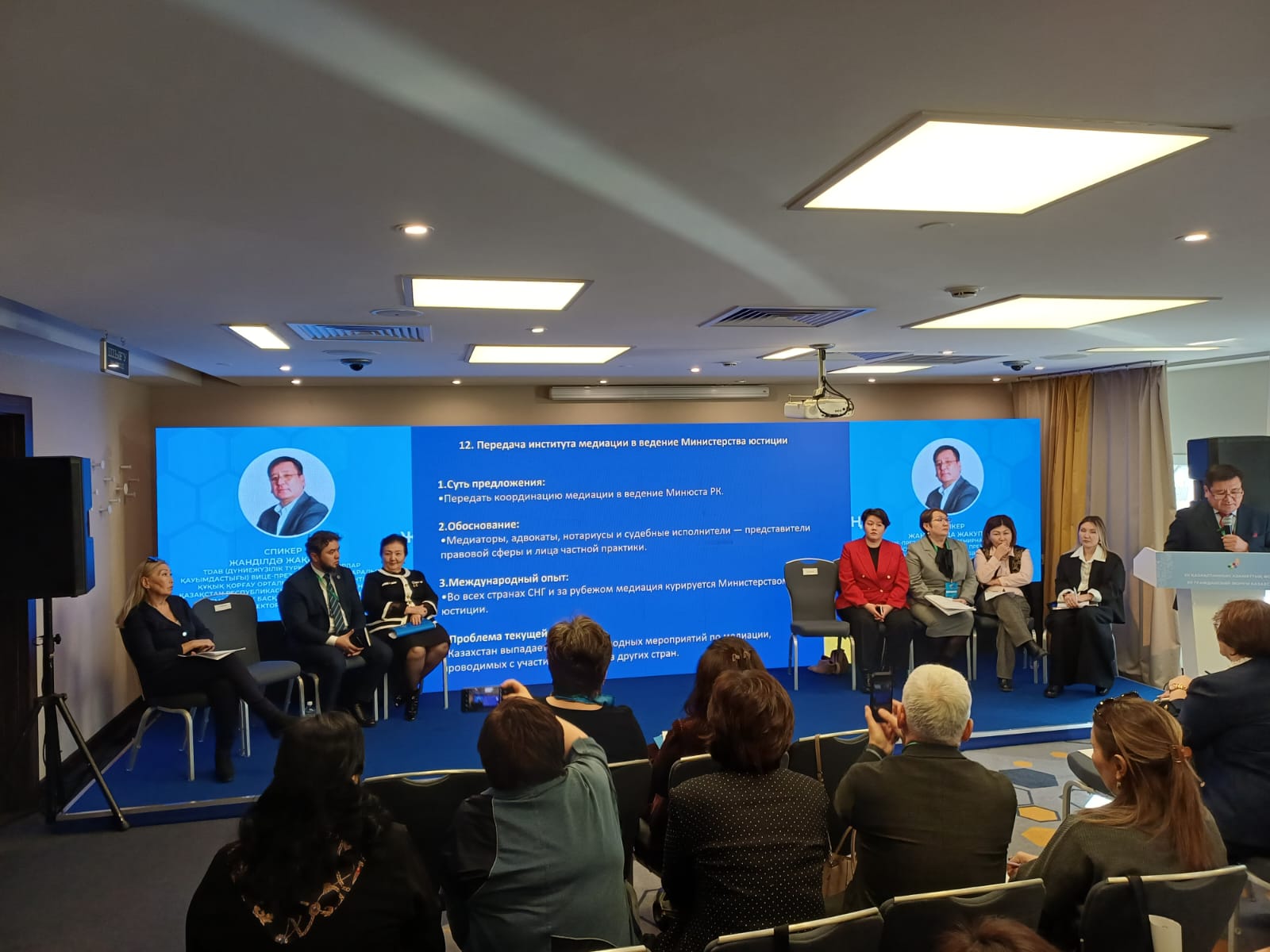


On October 15–16, 2025, the XII Civil Forum of Kazakhstan was held in Astana — the main platform for dialogue between the state and civil society. At the Mediation Section, MPC Director Zhandilda Zhakupov presented proposals on the need to reform the Kazakhstani mediation institute, taking into account international experience. The participants of the section supported his proposals and shared their vision for the future of mediation in Kazakhstan.
Text of the speech by Zhandilda Zhakupov:
Proposals for the Development of the Mediation Institute in Kazakhstan
Zhandilda Zhakupov
President of the NGO “International Human Rights Center”
Trainer-Mediator
Over the past two years, the Kazakhstani mediation institute has not received adequate development, despite the proposals we have submitted annually. Central Asian countries are entering a new stage of growth in the field of mediation: they are introducing mandatory informational sessions, reforming the organizational structures of mediation centers, establishing new rules and standards, and more. I once again present for discussion my proposals to strengthen the role of professional mediators, establish a unified Chamber of Mediators, and address other issues in the field of mediation:
-
Strengthen the role of mediators at the pre-trial stage of dispute resolution, including at the legislative level by making amendments and additions to the current legislation. Since 2016, court mediation has been developing, but by the time a lawsuit is filed, the parties have already turned to lawyers and attorneys for assistance, paid their fees, and paid the state duty — taking steps to bring the case to court. Therefore, pre-trial mediation is seen as more effective to prevent conflict escalation and avoid material and time costs for the disputing parties. For example, in Azerbaijan, mandatory informational sessions with a mediator for labor, family, and commercial disputes have long been used as an effective pre-trial dispute resolution tool. In Uzbekistan, investment disputes must involve mediators before filing a lawsuit. In Turkey, mandatory informational sessions are held for seven types of civil disputes (inheritance disputes, lease issues, labor disputes, etc.). In Kyrgyzstan, the Government adopted a Mediation Development Concept, which provides for mandatory pre-trial informational sessions with a mediator and the creation of a Unified Chamber of Mediators.
-
There is a need for Legal and Mediation Assistance Centers in each region for socially vulnerable groups who require assistance but cannot afford professional services. It is proposed to consider opening such centers in each region, funded through state social orders by local executive bodies, grants, or other sources. This measure will also contribute to achieving the Sustainable Development Goal of reducing inequality. This is especially relevant for disputes in banking and microcredit relations.
-
Initiate, develop, and adopt a State Program in the field of mediation and the preservation of social harmony, or a Concept for Mediation and Legal Assistance, involving all local executive bodies, judicial and other state authorities, professional and public mediators, as well as the Assembly of the People of Kazakhstan. This is particularly important in today’s political turbulence; preventive measures are needed to avoid conflicts and disagreements. Economic difficulties and the growth of socio-political conflicts require the development of a state-level dispute resolution system. The potential of mediation and the mediative approach in solving this problem is high.
-
Current legislation does not clearly regulate mediation by mediators when a state body is one of the parties. The norms of the Administrative Procedural Code, Civil Procedure Code, and the Law of the Republic of Kazakhstan “On Mediation” do not provide clear guidance, which may lead to incorrect application or interpretation of legal norms and consequences for mediation agreements or decisions made by state representatives. Therefore, amendments are proposed to legally authorize professional mediators to conduct mediations involving state bodies.
-
Consider the issue of free-of-charge activity of conciliatory judges and public mediators for all types of disputes and participants. The activity of conciliatory judges is funded by the budget and is free of charge; as a result, all civil disputes are resolved by them without restriction. The state duty is refunded to the parties if reconciliation occurs. This approach, however, discourages people from turning to professional mediators, develops a consumerist attitude towards the judicial system, and allows disputes to be handled without cost. Public mediators also operate free of charge, but they lack specialized mediation training and legal knowledge, although their agreements have legal effect. Their scope of work should be limited.
Consequently, it is proposed to:
-
Abolish the position of judge-mediator with corresponding legislative amendments, or amend the legislation to retain 50% of the state duty in cases of reconciliation by a conciliatory judge;
-
Exclude conciliatory judges as public mediators from the Law “On Mediation”;
-
Exclude retired judges from automatically becoming professional mediators without training;
-
Exclude or restrict public mediators without mediation training, limiting them to small claims and excluding criminal matters.
-
-
Improving the qualifications of mediators. The 2021 amendments to the Law “On Mediation” introduced the obligation for mediators to regularly improve their professional level according to government-approved training programs. However, these requirements are abstract and lack specifications regarding frequency or penalties for non-compliance. Regulations for trainer-mediators also need clarification to ensure training quality.
-
Ease the tax burden on professional mediators through amendments to tax legislation. Mediation is a social service aimed at conflict resolution and maintaining public harmony. Currently, mediators pay six types of taxes, with repeated social insurance contributions from each income type. In other CIS countries, taxes on mediators are significantly lower (e.g., Belarus charges only 13% income tax, while in Kazakhstan taxes range from 30–50%).
-
Maintaining a registry of mediator organizations by the authorized state body. Currently, the registry is on the Ministry’s website but contains inconsistencies, including multiple versions and organizations not having websites. Regulatory compliance and accurate registry maintenance are required.
-
To coordinate mediation development, establish a Unified National Chamber of Mediators or merge them into a Mediators’ Association including heads of mediator organizations on the board. Similar unified organizations exist in Azerbaijan and Kyrgyzstan.
-
Amend legislation to implement the Singapore Convention on Mediation for enforcement of mediated settlements. Kazakhstan has signed and ratified the Convention, but no further actions have been taken.
-
Consider Kazakhstan’s participation in the international mediators’ organization IQMed, established with a convention signed in May in Hong Kong. Founding membership is available only until the end of this year.
-
Transfer the mediation institute to the Ministry of Justice. Lawyers, notaries, private bailiffs, and mediators are legal professionals in private practice. In all CIS and foreign countries, mediation falls under the Ministry of Justice, ensuring Kazakhstan’s participation in international mediation events.
-
Continue promoting the mediation institute among the public and raise awareness about alternative dispute resolution methods. The population’s understanding of mediation remains insufficient, requiring further support from the authorized mediation body, judicial authorities, and others.
Additionally, it is necessary to exclude mediator organizations from the Law “On Non-Commercial Organizations” as professional and self-regulatory entities.