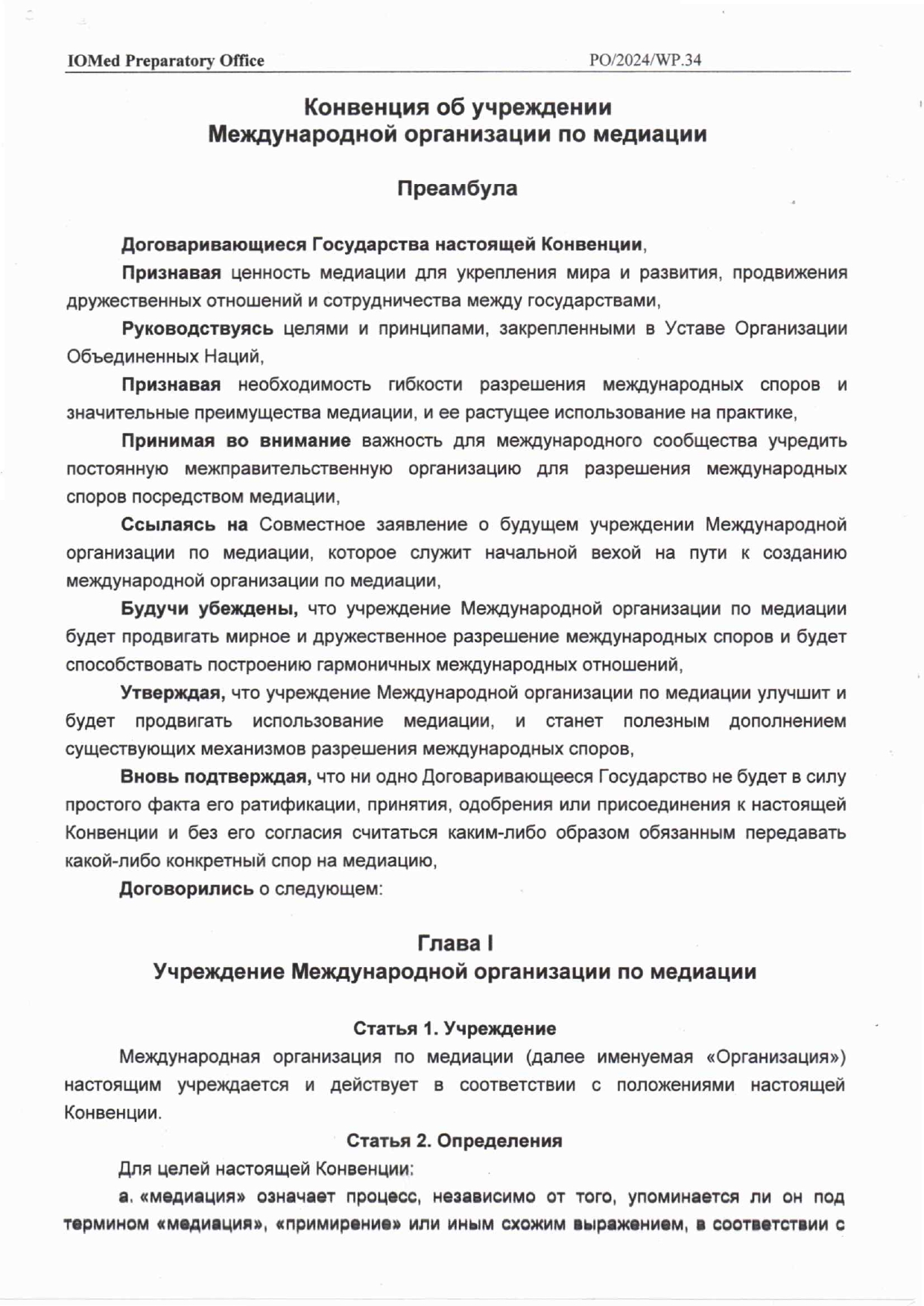


The Convention on the Establishment of an International Mediation Organization was signed on May 30, 2025 in Hong Kong. The opening ceremony was hosted by Chinese Foreign Minister Wang Yi and attended by representatives from over 30 countries (Pakistan, Indonesia, Belarus, Cuba, as well as organizations such as the United Nations). The signatories of the Convention are States from Asia, Africa, Latin America and the Pacific region. The International Organization for Mediation is positioned as the world's first intergovernmental legal body specializing specifically in mediation of international disputes. The headquarters is located in Hong Kong. The text of the Convention is posted on the IPC website at the link https://mpc-info.kz/ru/o-mediatsii/item/3961-konventsiya-ob-uchrezhdenii-mezhdunarodnoj-organizatsii-po-mediatsii-kitaj
According to this Convention, the head of the IPC, Zhakupov J.A., and the coordinator of the IPC, Zamanbekova A.O., issued an article with the following content:
On the Convention on the Establishment of an International Mediation Organization
Zhakupov Zhandilda Azhigalievich,
President of NGO "International Human Rights Center",
mediator, mediator coach
Zamanbekova Aida Orysbayevna,
Coordinator of the Mediation Center
NGO "International Human Rights Center",
mediator, mediator coach
The Convention on the Establishment of an International Mediation Organization was signed on May 30, 2025 in Hong Kong. The opening ceremony was hosted by Chinese Foreign Minister Wang Yi and attended by representatives from over 30 countries (Pakistan, Indonesia, Belarus, Cuba, as well as organizations such as the United Nations). The signatories of the Convention are States from Asia, Africa, Latin America and the Pacific region. The International Organization for Mediation is positioned as the world's first intergovernmental legal body specializing specifically in mediation of international disputes. The headquarters is located in Hong Kong.
It is indeed a very interesting initiative to create a unified international mediation organization. Until now, there was no structure that would cover all countries and offer a single standard for international mediators. If such an organization is created, it can significantly change the sphere of international dispute resolution, and give a new round to the development of the institute of mediation in all countries, strengthen the importance of this institution and enhance the status and role of a mediator both at the national and interstate levels.
The key points that stand out in the proposed convention are:
1. The world's first association of its kind – there is currently no international mediation organization with a single certificate format and standards.
2. Only States or integration associations can be members, and private organizations of mediators cannot be members directly.
3. Financing is provided by contributions from States, which confirms the serious level of this structure.
4. Creation of two lists of mediators – international mediators and interstate mediators appointed by the participating countries.
5. Immunity of mediators – privileges and protection for mediators during the performance of their functions, which is similar to diplomatic status.
6. Payment for the services of mediators is 50% to the mediator, 50% to the organization, while the fees of mediators are not taxed.
7. The deadline for signing is limited to 2025, with the possibility of joining within two years.
8. Kazakhstan is invited to sign and discuss, which opens up prospects for the country in the development of international mediation.
The mechanism of public-private partnership here looks unusual and thoughtful. The state undertakes financial obligations to support the organization, but does not interfere in the mediation process itself, providing this work to professionals whom it also recommends. This creates a balance between government control and the independence of mediators.
The main points that Kazakhstan should consider in this matter:
1. Mandatory participation in discussions
• Kazakhstan really needs to attend the presentations and discussions in order to get the most information.
• It is necessary to understand which countries support the initiative and who advocates signing it.
2. Analysis of the initiative before signing
• A thorough analysis of this very important and serious innovation document is needed.
• Kazakhstan should assess the possible risks (if any) and benefits, especially in the context of its geopolitical position.
3. Mandatory inclusion in the delegation of representatives of mediation organizations or mediation experts, except for representatives of government agencies or ministries. Without professionals who are deeply versed in mediation practice, it will be difficult to assess the prospects for participation. It may also be worthwhile to involve representatives of the legal community and business, as they will be the main users of this system.
4. Coordination with neighbors (Central Asia)
• Central Asian countries often face similar problems in international disputes.
• A unified position of neighboring countries can strengthen Kazakhstan's negotiating positions and help develop common approaches.
5. Financial model and long-term obligations. It is necessary to understand how Kazakhstan is ready to incur regular financial obligations if it joins this organization. What control and reporting mechanisms are provided?
There is also a question of the independence and impartiality of mediators, especially if the financing of their activities is somehow related to the state. Indeed, unlike the existing global mediation organizations, where mediators are independent private specialists, the new international mediation organization risks that government involvement will influence their decisions.
Key challenges and risks related to the independence of mediators in the new organization:
1. Government funding
• If the State pays the fees and the mediators are appointed by the same State, a conflict of interest may arise.
• How to ensure that mediators are not biased in favor of their countries?
2. Selection and control procedures for mediators
• What criteria are set for inclusion in the lists?
• How will the professionalism and impartiality of mediators be ensured?
• Who will check their qualifications and compliance with international standards?
3. Guarantees of neutrality
• Are there any mechanisms that prevent the political influence of States on the decisions of mediators?
4. Comparison with existing models
• Unlike JAMS (USA), CEDR (UK), and IMI (Global Network), the new structure has government involvement, which may affect the perception of its decisions. What should Kazakhstan consider before joining the organization?
• To study the mechanisms for ensuring the independence of mediators, prescribed in the charter and the convention.
• Find out who will appoint mediators, what are the requirements for their selection, and what is the rotation and control system.
The main challenge for this organization is the balance between state participation and the independence of mediators. Kazakhstan needs to approach this issue very carefully to make sure that the new structure will really work effectively and impartially.
Kazakhstan really should participate in the discussions, but the issue of signing requires deep consideration. It is important to assess how the organization will work, which countries will support it, and what benefits it will bring to Kazakhstan in the long term.
One of the important issues is the issue of cross-cultural mediation, which has not yet been covered in the convention. The inclusion of mediators from different countries in the dispute resolution process requires not only professional competence, but also a deep understanding of the cultural characteristics of the parties.
Key challenges of cross-cultural mediation within the new organization:
1. Differences in the perception of conflict and ways of its resolution
• For example, in Japan and Korea, the concept of “avoiding conflict” and finding solutions that preserve the “face” of the parties traditionally dominates.
• In the USA and Western countries, the approach is more straightforward and focuses on legal reasoning.
• In Arab countries, negotiations through intermediaries, respect for authority and personal connections are of great importance.
2. Language barrier and interpretation
• How will the language accessibility of the process be ensured?
• Will mediators be required to work only in international languages (English, French) or will professional translators be involved? The result of mediation depends on the quality of the translation, small inaccuracies can significantly change the perception, meaning and possibility of concluding an agreement.
3. Requirements for mediators in the field of intercultural communicative competence
• Currently, the convention does not require mediators to have knowledge of cross-cultural communication.
• It is necessary to develop additional standards for the selection and training of mediators in this area.
4. Development of internal documents of the organization
• Most likely, the Governing Council of the organization will eventually introduce additional standards and regulations regarding the intercultural training of mediators. It is important for Kazakhstan to actively participate in the development of these standards in order to influence the formation of transparent and understandable criteria.
We can suggest the following solutions to this issue::
✔ Include the requirement for cross-cultural training of mediators in the organization's documents.
✔ Develop a certification system for international mediators, including cross-cultural mediation training.
Create a list of “recommended international mediators" who have knowledge about the specifics of intercultural and interethnic mediation.
✔ Introduce mandatory educational modules on cross-cultural mediation for mediators working in this organization.
✔ Introduce mandatory educational modules on cross-cultural mediation for mediators working in this organization.
If this point is not worked out, there is a risk that mediators will not be able to effectively resolve conflicts between representatives of different countries. Kazakhstan should initiate a discussion on this issue in the framework of the upcoming negotiations and propose the introduction of additional standards for the selection of mediators, taking into account their ability to work in a cross-cultural environment.